🔥 Black Friday 25% OFF all plans with the code QUICKHUNTBFCM25
Offer Ends
00
Days
00
Hours
00
Minutes
00
Seconds
Get The Discount!

Editly is a Shopify order editing app designed to give customers more control after checkout. Instead of contacting the merchant every time they need to make a change, customers can edit their orders themselves.
With Editly, merchants can let customers update shipping addresses, change variants, adjust quantities, add or remove products, change shipping methods, and cancel orders based on the rules they configure.
The goal is simple: make post-purchase changes easier for customers while reducing the support workload for Shopify merchants.
“Customers shouldn't have to contact support for every small change to their order. Editly gives them the freedom to make those changes themselves.”
But as Editly grew, the team saw another opportunity.
The same customers who needed help with order editing were also sharing valuable ideas about what they wanted next.
For Editly, customer support conversations often started with a simple question.
A merchant might ask how to change a customer's shipping address. Another might want a longer cancellation window. Someone else might request a new way to handle order modifications.
Each conversation could contain useful product feedback.
The challenge was making sure those insights didn't get lost after the immediate support question was answered.
“A support conversation can solve one problem, but it can also reveal a problem that many other customers may have.”
Editly needed a better way to connect customer conversations, feedback, feature requests, and product development.
Editly introduced Quickhunt live chat to make it easier for customers to communicate directly with the team.
Instead of leaving the app or searching for a separate support channel, customers can open the Live Chat and start a conversation from within the product.
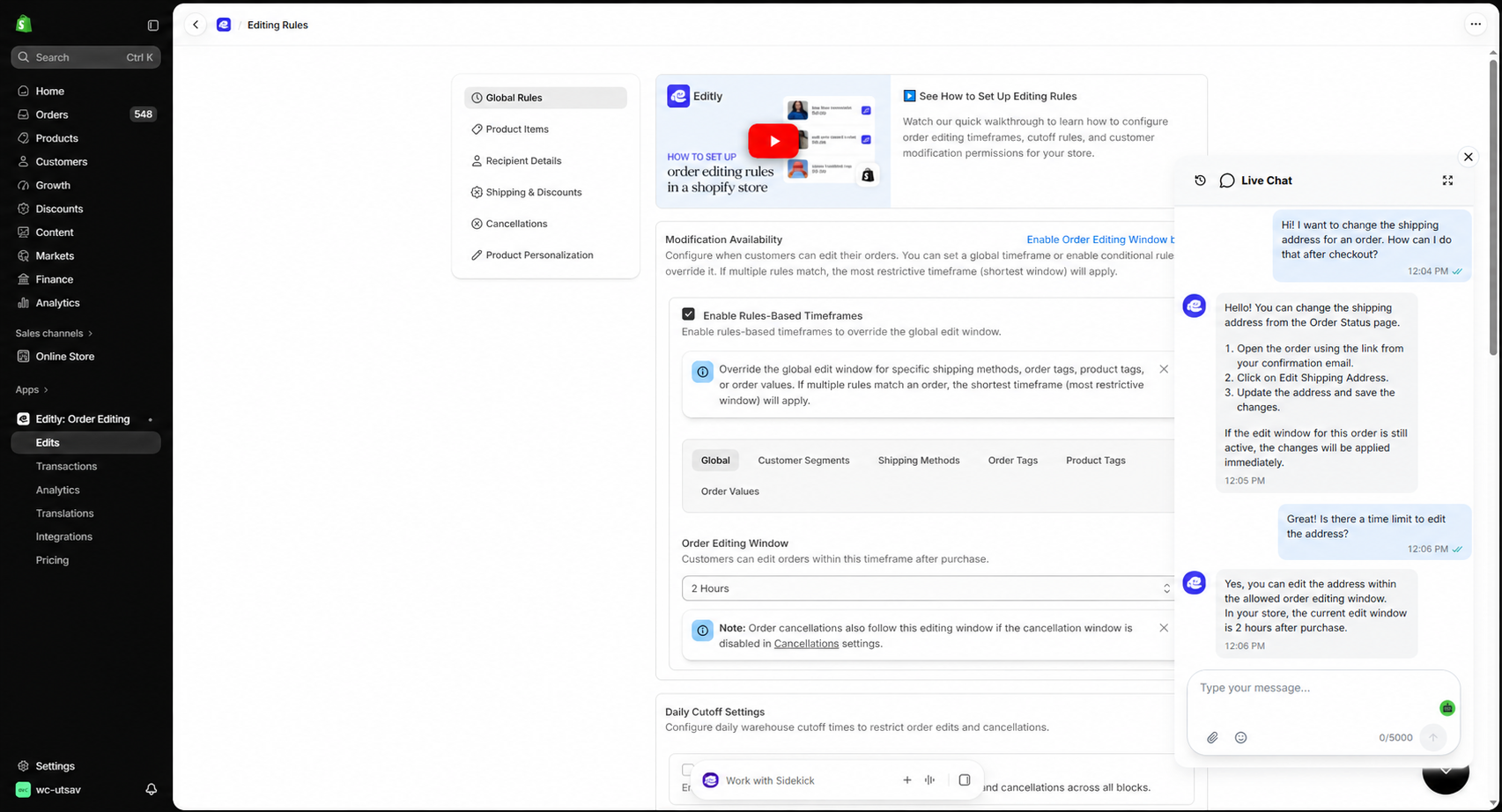
This creates a much shorter path between a customer's question and the support team.
Whether a customer needs help understanding an order-editing feature or wants to ask about a specific workflow, they have a direct way to start the conversation.
“We wanted customers to have an easy way to reach us when they needed help. Live Chat makes that conversation feel immediate and natural.”
The real value appeared when Editly started looking beyond individual support conversations.
A customer asking for a feature could represent a much larger need.
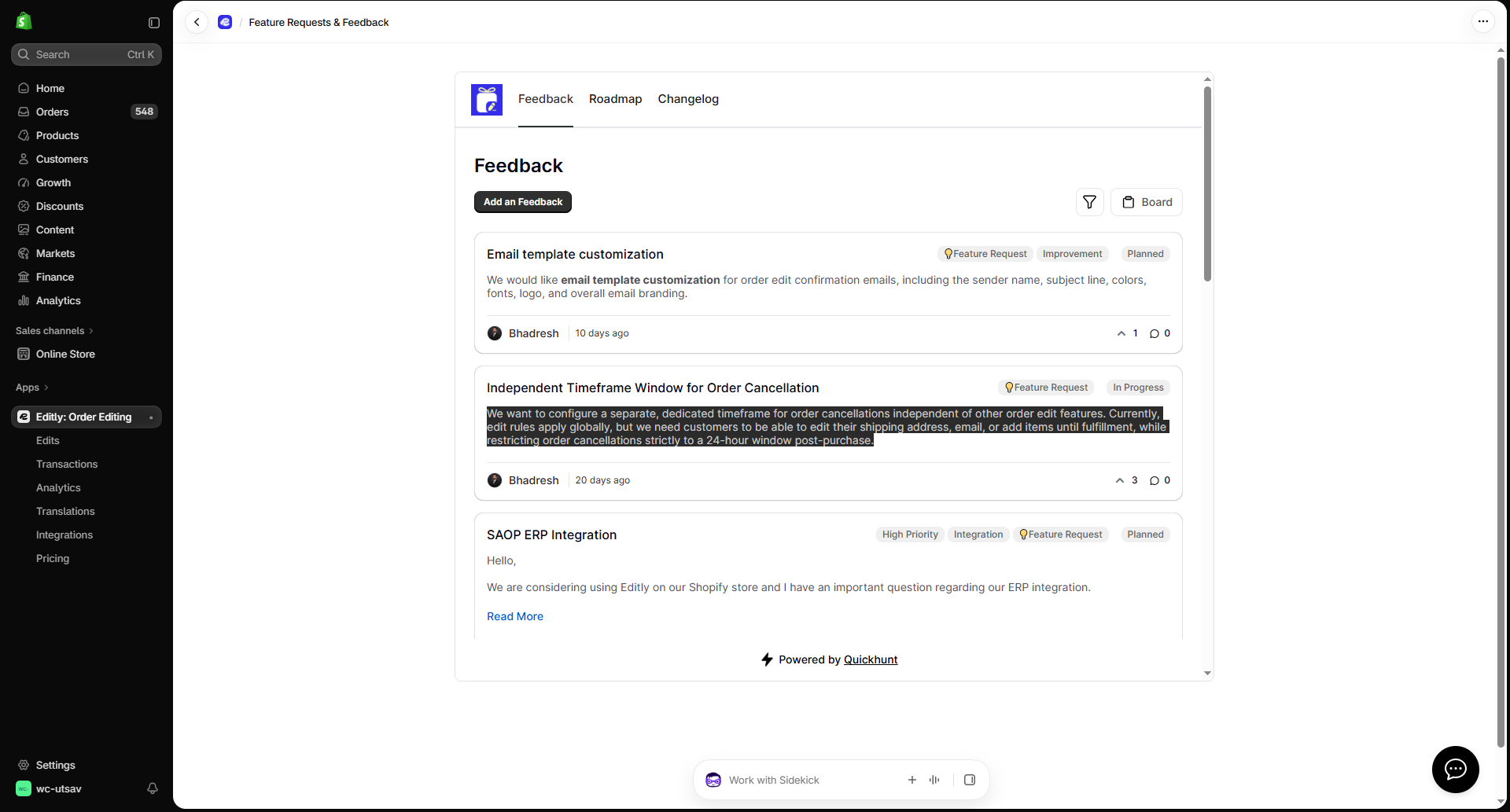
For example, Editly received a request for an independent timeframe window for order cancellation. The customer wanted cancellation rules to work separately from other order-editing permissions.
Instead of keeping that request inside a private support conversation, Editly could bring it into its structured feedback process.
The request became visible as a product idea, where the team could understand the demand, discuss it, prioritize it, and communicate its progress.
This gave Editly a much clearer picture of what customers were asking for.
Quickhunt's customer feedback portal gives Editly a dedicated space where customers can submit and follow product requests.
Requests can move through different stages, helping customers understand whether an idea is planned, in progress, or still being considered.
That transparency changes the customer relationship.
Customers aren't simply asking for features and waiting for an unknown outcome. They can see that their feedback has been heard and is becoming part of the product conversation.
“Customers want to know that their feedback matters. When they can see an idea being considered or moved forward, it creates a much stronger connection with the product.”
Once customer feedback is organized, the next step is deciding what should actually be built.
This is where Editly can connect feedback with its product roadmap.
Instead of making product decisions based only on internal assumptions, the team can look at actual customer requests and identify recurring problems.
A feature request that appears repeatedly can become a stronger candidate for the roadmap.
This creates a simple but powerful feedback loop:
Customer conversation → Customer feedback → Product decision → Roadmap → Product improvement
Building a feature is only part of the process.
Customers also want to know when something they requested becomes available.
Quickhunt's Changelog helps Editly communicate product updates and improvements back to customers.
This closes the loop that started with a customer conversation.
A customer asks for something.
The team understands the need.
The request becomes part of the product process.
The feature gets built.
The customer can then discover the improvement through the changelog.
“The best feedback loop is one where customers can see what happened after they shared an idea.”
For Editly, Quickhunt became more than a place to collect feature requests.
Live Chat helps customers get support when they need it.
Feedback helps the team understand what customers want.
The Roadmap creates visibility into what is being worked on.
The Changelog communicates what has changed.
Together, these experiences help Editly create a continuous conversation with its customers.
Instead of treating support and product development as two separate activities, Editly can use customer conversations as a source of product insight.
Editly's approach demonstrates an important shift in how SaaS teams can think about customer support.
Support conversations aren't just tickets to close. They're opportunities to understand the product from the customer's perspective.
Every question can reveal friction.
Every feature request can reveal demand.
Every repeated problem can reveal a product opportunity.
And every improvement can become a reason to continue the conversation with customers.
“Quickhunt helps us turn customer conversations into something actionable. We can listen, understand, build, and then come back to customers with something better.”
For Editly, that means customer support is no longer just about answering questions.
It's becoming part of how the product gets better.
Use Quickhunt to collect customer feedback, plan your product roadmap, and share updates with built-in changelog tools. No coding is needed, just simple steps and fast value.

.svg "footer-logo")





Quickhunt helps SaaS teams collect feedback, manage ideas, plan roadmaps, and share updates through announcements and interactive in-app messages like surveys and checklists.
.svg "fecebook")
.svg "linkdin")
.svg "twitter")



.png)